An Ode to My Wife

It's Sunday afternoon. We just got home from church and I can hear Caroline clanking the pots and pans in the kitchen as she prepares the last lunch she'll have to make for me until mid-October. I'm not sure how she'd feel if she knew I were hijacking her blog, but the Army shut down my own blog so this is all I have to work with.

I am Caroline's husband Justin. Most of you who know Caroline don't know me because I surfaced during a transition period in her life. Caroline was ready to go to a master's program in London before I offered her a luxurious, carefree life in Fayetteville, North Carolina. For some reason, she chose me over London, and I am so grateful she did.

Caroline is one of the kindest women I've ever known. I see it more every day and it humbles me that a person like her would choose to spend her life with a man like me. I'm a guy's guy. I watch sports and South Park. I am a combat soldier who genuinely enjoys the risks that my occupation entails. And yet somehow, I have this wonderful woman in my life that dulls my rough edges and coarse exterior.

There are 4 types of people in this world: people who we know, people that we don't know, people that we wish we didn't know, and, most importantly, people that we are grateful to have in our lives. Caroline is without question in the latter category for me. Her brilliance, her kindness, her smile, her quiet beauty grace my life every day.

I have to leave for more combat training tomorrow morning for 10 tough weeks. The only thing that keeps me from gushing with excitement to learn more of my craft is the simple fact that I won't be with my wife. From waking up next to her, I go to waking up in the woods next to a camouflaged man who hasn't bathed in days. That's hardly a good trade. But the training I get will qualify her and I for a better military life, a more comfortable life, and she is worth every hardship that will come over the next few months.

I love my wife more than I ever thought I could love another person. I hope you know Caroline because she has a presence about her that brightens rooms and lives. If you see her over these next few months, take good care of her for me. And remind her how much I love her.

The Woes of the Woman


There was a great article in the Washington Post yesterday about working moms in Congress. The story focused on the ten congresswomen who have children under the age of eleven. It was really interesting to read how these women balanced their work and family life. Every week they have to shuttle between their congressional districts (where their family live) and Washington, DC (where their career is located). It seems like such a hectic life, but they all make it work somehow. And as a woman, I am really proud of them for doing it.

Yet there was a small portion of the article that made me sad. In the article, the point was made that men running for office get kudos from voters for raising young children--but women are often penalized for it.
For male candidates, people think having young kids is a total plus. They believe such a man would be concerned about family values and that he would be more "future-oriented." Women candidates, however, face an uphill battle if they have little children. Their voters often wonder who's at home minding the kids when their mom is on the campaign trail.

First, I think it's unfair to women in congress that they cannot be good mothers and good politicians. Obviously this a hard road to head down, but it is not an impossible one. The women in the article demonstrate that they try their hardest to be the best moms that they can be while serving our country at the same time. They fly home for piano concerts and they check their children's homework every night--sometimes via fax. These women show that you can put your family first and succeed in your career. Of course, sacrifices must be made, but such a thing can be achieved.

Secondly, I also find it unfair that nobody questions the various congressmen who are raising young children about their abilities to be good fathers. Congressmen and congresswomen share the same political responsibilities---yet why is it that only female politicians are questioned about their parenting skills? It's interesting that men are applauded for balancing the two realms of work and family, yet women are criticized for doing the same thing.

And lastly, I feel really lucky to live in a time when more and more women are serving in the Senate and the House. For the first time in our history, we have a woman as the Speaker of the House and an African-American woman as the Secretary of State. I know there is ground that still needs to be broken when it comes to leveling up the playing field, but the strides we've made thus far are truly inspiring.

Anyway, it is a great article. Take a gander if you have the time.

We, the Southerner


On a warm Sunday in 1963, four black girls dressed up for a special youth program at their church in Alabama. The girls wore white dresses and they were primping inside the basement when a bomb exploded by the church stairwell. All four were killed. The bomb had been planted by the KKK.

Gene Patterson, the editor of the
Atlanta Constitution, was mowing his lawn when he heard the news of the Sunday blast. Patterson quickly started writing a column for the paper's Monday edition. He contacted reporters on the scene in Birmingham and was particularly captivated by a report that a mother was walking around the church ruins, holding a shoe from the foot of her dead daughter. The editor decided to address his column to his fellow white southerners:

A Negro mother wept in the street Sunday morning in front of a Baptist Church in Birmingham. In her hand she held a shoe, one shoe, from the foot of her dead child. We hold that shoe with her.


Every one of us in the white South holds that small shoe in his hand.

It is too late to blame the sick criminals who handled the dynamite. The FBI and police can deal with that kind. The charge against them is simple. They killed four children.

Only we can trace the truth, Southerner---you and I. We broke those children's bodies.

We watched the stage set without staying it. We listened to the prologue unbestirred. We saw the curtain opening with disinterest. We have heard the play.

We---who go on electing politicians who heat the kettles of hate.

We---who raise no hand to silence the mean and little men who have their nigger jokes.

We---who stand aside in imagined rectitude and let the mad dogs that run in every society slide their leashes from our hand, and spring.

We---the heirs of a proud South, who protest its worth and demand it recognition---we are the ones who have ducked the difficult, skirted the uncomfortable, caviled at the challenge, resented the necessary, rationalized the unacceptable, and created the day surely when these children would die.
This is no time to load our anguish onto the murderous scapegoat who set the cap in dynamite of our own manufacture.


He didn't know any better.

Somewhere in the dim and fevered recess of an evil mind he feels right now that he has been a hero. He is only guilty of murder. He thinks he has pleased us.

We of the white South who know better are the ones who must take a harsher judgment.

We, who know better, created a climate for child-killing by those who don't.

We hold that shoe in our hand, Southerner. We hold that shoe in our hand, Southerner. Let us see it straight, and look at the blood on it. Let us compare it with the unworthy speeches of Southern public men who have traduced the Negro; match it with the spectacle of shrilling children whose parents and teachers turned them free to spit epithets at small huddles of Negro school children for a week before this Sunday in Birmingham; hold up the shoe and look beyond it to the state house in Montgomery where the official attitudes of Alabama have been spoken in heat and anger.


Let us not lay the blame on some brutal fool who didn't know any better.

We know better. We created the day. We bear the judgment. May God have mercy on the poor South that has so been led. May what has happened hasten when the good South, which does live and has great being, will rise to this challenge of racial understanding and common humanity, and in the full power of its unasserted courage, assert itself.

The Sunday school play at Birmingham is ended. With a weeping Negro mother, we stand in the bitter smoke and hold a shoe. If our South is ever to be what we wish it to be, we will plant a flower of nobler resolve for the South now upon these four small graves that we dug.

Journalism 101

There is a mantra amongst journalists to become the ultimate "detached observer." The reporter's duty is to observe current events and to document them in a balanced manner. In no way should a journalist insert himself into a story. He is not there to influence unfolding events; he is not there to change things. He is there to watch.

But are there exceptions to the rule?


In the fall of 1957, a fifteen year-old girl named Elizabeth Eckford got off a municipal bus and headed towards her school. She held her books against her chest and she wore sunglasses to cover the fear in her eyes. A large crowd had gathered outside the school and people shouted at her.

"Go back where you came from," one woman yelled.

"Don't let her in our school," called out another.


Elizabeth Eckford was black. She was part of a group of nine African-American students who attempted to integrate Little Rock schools in 1957. The students planned to meet that morning so they could all head to school as a group. But no one was able to reach the Eckford's because the family did not have a telephone. So Elizabeth, who arrived early, headed to school alone and faced the crowds and soldiers by herself.

Elizabeth walked up to the entrance and tried to go into the school, but she was turned away by the National Guard. The governor of Arkansas had sent in state troops to prevent school integration. Elizabeth tried to enter the school a second time, but again she was rebuffed. She was stuck. She walked back to the bus stop and took a seat on the bench, hoping anxiously that a bus would arrive soon. The angry mob followed her, shouting more jeers and epithets at the fifteen year-old girl.

Benjamin Fine of the New York Times had watched the entire seen unfold.
As he watched tears dribble down Elizabeth's cheeks, he couldn't help but think of his own fifteen-year old daughter. He sat down besides the girl and put his arm around her. Gently lifting her chin he said, "Don't let them see you cry."

Fine's actions are criticized in the book The Race Beat: The Press, the Civil Rights Struggle, and the Awakening of the Nation. The writers of the book decry Fine as being "completely inappropriate" and "provocative." And in the traditional journalistic sense, the writers are right. Fine did step out of bounds and he may have provoked the angry crowd. He broke the rules of Journalism 101. But are his actions wrong?

In my mind, Fine did the right thing. He understood that his actions would break certain journalistic rules, but he also couldn't withhold his comfort from a scared young teenager. I'm sure at the end of the day, Fine felt no regret for sitting down on that bus bench and putting his arm around Elizabeth Eckford. Would he have felt the same way if he had remained a silent observer in the crowd?

I'm not one to judge when and where a reporter should lay down his journalist duties. I'm sure it is a very fine line of what is appropriate and what is not. But I am proud of Ben Fine for following his heart. Whether or not his actions were right or wrong, he did the best humanly thing. He stood up against hate.

The Woman Who Sang Too Loudly


If you are a Mormon, then you are probably familiar with the woman-who-sings-too-loudly-in-church phenomenon. Every ward has one. You know, that lady who projects her voice so loudly that it drowns out the rest of the congregation. She is the one who feels like sacrament meeting is a time to brush up on her amateur soprano career.

Some people are able to tune out this squawking voice, but I cannot. My husband can, but I cannot. My favorite part of church is singing hymns---I love reading the lyrics and hearing the ward's voices blend together. Music touches my soul and I look forward to learning new songs or singing old favorites. But it's hard to get in touch with my soul when Sister G. bellows from the front pew and fills the room with her semi-off-key operatic performance.

Sister G. is my nemesis at church. She became my nemesis in Sunday School a few weeks ago when we were discussing the story of Jesus and the rich man. My husband offered his perspective on the story and everyone in the classroom nodded and hummed in agreement. But one person didn't like what she was hearing and shot her hand up in the air.

"Well, that's not what this story is really about. It's about this..." said Sister G.

Oh ho! If we were living in 18th century France, I would have spit on the ground and challenged her to a duel. But I didn't because spitting is rude and I forgot to bring my sword to church. (Ba-dum-ching)

There are other reasons why Sister G. has become my nemesis but I won't reveal them here because my guilty conscious is kicking in and I feel like I shouldn't say more negative things. (But not guilty enough to erase this blog. Thus I am evil.)


I know there will be those who will chide me to forgive and to love and to befriend. And indeed, I believe in all of these things. I will also be the first to admit that I can be a prideful and surly wench at times.


But have you
heard the woman sing at church???

Oprah's Book Club Ain't So Bad


This month I joined millions of Americans in reading Oprah's newest book selection The Road by Cormac McCarthy. I'm usually not a huge follower of Oprah's book club, but I have admired her choices in the past (especially when she went on that Great Works kick). I'm also not a very big follower of Cormac McCarthy, but I've heard in my English classes that he is one of the best living writers in America.

The Road is set in a post-apocalyptic America that has been decimated by some natural disaster or atomic war. (McCarthy never defines what actually happened.) In this future America the sky is always gray and the landscape filled with dust. There are no trees or animals. Nothing lives except for a handful of human survivors, many of whom have turned to cannibalism.

The story follows a father and his son as they walk to the south---to the sea---to escape the winter's cold. They have very few material possessions: cans of food they found in long-abandoned homes, blankets to keep them warm at night, a small bottle of gasoline to fuel their small lighter, and a shopping cart to carry it all. But their most valuable possession is one another---for "each is the other world's entire."


As I read
The Road, McCarthy's simple prose pulled me into this dark gray world of some near future. I could see the barren land before me and I could feel the cold of the bitter nights. And I felt the desperation of the father as he cooked the last can of food for him and his son. Where could we get more? How would we survive? The sun shone brightly outside my apartment but inside I felt cold and sad.

Yet McCarthy offers a bit of light in the story and this light rests in the boy. Despite his horrible surroundings, the boy is infinitely innocent and infinitely good. When the two pass an old man on the road, the boy begs his father to give the man some of their food. When the father catches a thief who stole of their possessions, the boy pleads for the thief's life. Perhaps the boy is naive but his kindness is so surprising in a world that no longer knows good.


A fantastic book. Very beautiful writing, very powerful characters, a very interesting way of organization (the book has no chapters; it's just composed of short paragraphs). I would highly recommend it.

The Midnight Thoughts of a Military Wife

Sometimes I look at my husband and I think about him dying. I really don't mean to think about such an awful thing but the thought finds its way into my mind a few times a week. I can be driving to the grocery store, just fiddling around with the radio station, when I pass a tree with a big yellow ribbon tied around the trunk---and I think about losing Justin. Or I will be watching the local news and I hear the newscaster announce that there has been another war casualty from Fort Bragg. And suddenly I'm very grateful that Justin is still in training and still a year away from deployment.

But usually when I think about my husband dying we will be lying next to each other in bed. He will be sleeping next to me and I will be awake listening to his deep slow breaths. He mutters softly to himself and I think he must be dreaming. Lost in some subconscious world where I cannot join him.

Sometimes in the middle of the night Justin will have a nightmare and he wakes up shaken and clammy. He turns to me and pulls me into his big arms and I try my best to soothe him. Yet I am the one who feels comforted as I am swallowed up by his two arms with my face nestled against his chest. His heartbeat sounds like a bass drum in my ear: beating in strong and steady steps, beating life through Justin's body. And this is when I think about losing him the most.

When Justin and I first started dating I
tried not to think about the possibility of him dying or of him even going to war. He was just an all-American boy with green eyes and a casual smile and I was just a girl trying not to fall in love with him. On one of our first dates we went to a small bakery to have lunch and we sat at our table for an hour reading the newspaper and talking about the articles we had passed between us. It felt like we were seventy years old and married for forty-five. My heart had found its home.

One night I asked Justin if he was afraid of dying and he told me no. The only thing that worried him, he said, was his mother. His death would break her heart and the thought of that broke his own. I wondered if he knew that my own heart would fall apart too if he died on some battlefield in some foreign land, but I didn't tell him this because our relationship was new and we weren't supposed to talk about things like soul mates or death. So instead I asked him about politics and traveling and books and even war. And I didn't say much about dying.

I forced myself to push away my nightmares about losing Justin because it wasn't like we were married. We weren't even engaged. We were just dating and having fun and I wanted to enjoy myself without thoughts of doom looming in my conscious. Besides, I would be heading to London in a few months to start graduate school and I would probably never see him again. Our relationship would be one of those old summer romances that faded away like lightning bugs in the winter.

But as the summer drew to a close I realized I wanted more time with Justin. Even more than I wanted a year in England. My mother scolded me for being so foolish as to defer graduate school for a boy---and sometimes I wondered if she was right and if I was making a mistake---but in the end I chose to follow my heart. I stayed behind in America to be with a boy. I stayed behind to marry a soldier whose uniform made my eyes well with pride and my heart tremble in fear. My worrying days had begun.


Sometimes I am the one who wakes up Justin in the middle of the night, crying into his thick shoulder. He asks me what is wrong and I mumble that I am so afraid of losing him. His arms tighten around me and Justin whispers softly that he will always come home to me---he makes this promise to me. I can think of no response except to cry harder and nod meekly.

"Don't you believe me?" he asks and even in the darkness I can tell that his eyes are filled with concern.

"Yes," I stammer but I am lying. I will always worry about him.

In a few minutes my exhausted husband falls asleep again and I curl up beside him. For now he is safe in our bed and I must be grateful. This is a gift. But still I lie in the blackness, staring into nothing, and thinking about my husband's destiny.

On Books


I've been on a bit of a book rampage lately. Does anyone else experience this? I'll go without reading a book for a few weeks and then I'll have this sudden hunger for the library or bookstore. And then I'll just read for days and days until the hunger is satiated; all the while my husband becomes a little sad because all I do is read and I can't seem to tear myself away from the pages.

For the past year or so I've really enjoyed reading young adult fiction. Something draws me to this genre. I think this is because I had such good experiences with reading as a little girl and the books I read back then still resonate with me today. And so, I looked up a list of Newbery Award winners because I figured these books would all be good reads, and I headed to the library.


Here are some of the books I've read thus far and what I've thought of them:


1.) The Hero and the Crown by Robin McKinley. What I liked most about this book is the protagonist---Aerin, a princess in a male-dominated kingdom. She's strong, tenacious, fiery and she fights dragons. The story flows well and McKinley does a fine job of creating a fantasy world that is believable. It's also a very mature book for the younger reader; I wouldn't call it a kid's book really, more for young teens.

2.) The Midwife's Apprentice by Karen Cushman. I read another book by Cushman a few months ago and I really enjoyed her dry wit and straightforward voice. Cushman does an excellent job of intertwining medieval history and culture into a book geared for children. It's a very short read and very enjoyable. Highly recommended.

3.) The His Dark Materials trilogy by Philip Pullman. These books aren't Newbery winners, but they really are a great read a la Harry Potter. I'm really impressed by the intricacy of the trilogy and how it weaves a lot of religious history and philosophy into the story. The story begins innocently enough with a girl named Lyra but it gradually expands into this vast epic about the war in heaven, multiple universes, and even the end of the world. Very entertaining. I'm really excited to read the third novel and finish off the trilogy.

4.) Bud, Not Buddy by Christopher Paul Curtis. This is another Newbery award book, but I'm only a few pages in. I really like what I've read so far though---the introduction of an orphan named Bud who wants to find his father. The book is set amidst the Great Depression in Flint, Michigan.

5.) March, by Geraldine Brooks. This isn't a Newbery award winner or even a kid's book, but I thought I'd throw an adult work into this list. March won the 2006 Pulitzer prize for best fiction and I truly enjoyed this book. Brooks writes the novel from the perspective of Peter March, the beloved yet absent father in Louisa May Alcott's Little Women. The story follows March as he works as a chaplain in the Union forces during the American Civil War. During the course of his travels, March writes letters home to his wife Marmee and their four "little women." A really great read that provides a lot of interesting commentary about slavery too. I've never read Little Women, but perhaps now I will...

What are you?


There is a mysterious vegetable in my refrigerator. It is green with curly leaves and it kind of looks like a spiky version of lettuce. I've poked at it and even tried a bite of it, but I can't figure out what it is.

It all started last week when I went to the grocery store for some arugula. I have never seen an arugula before, but I needed it for a recipe I was trying out. I walked around the produce aisle for awhile, trying to figure out what was an arugula and what wasn't, and then I finally found it. Well, at least I found the sign for it. So I picked up this weird spiky-looking vegetable---and I really doubted that this was arugula since I've heard that arugula kind of resembles spinach leaves---but I wasn't one to debate a produce-section sign.

So I took this foreign vegetable home and then I decided it just can't be arugula because it looked nothing like the picture of the recipe that I was trying to make. But I also don't have the heart to throw away this strange pointy lettuce because I don't like wasting food. Yet I don't really want to eat it either.

And so, the vegetable sits in my refrigerator and I've deduced it must be some strange alien from the next galaxy over that is trying to takeover the world by masking itself as arugula. But I've outsmarted this evil alien vegetable and it will be forced to re-think its plans as it freezes slowly in my crisper bin.


(I think it might be kale...)

The Weddin'

Here are some more photos of the wedding day. Enjoy!


The Mommy Wars is getting old

In Sunday's Washington Post, feminist Linda Hirshman wrote an editorial about the income gap between American men and women. Even in our supposedly equal 21st century, a woman's salary is a mere 69% of her male counterpart's. This is indeed a sad statistic.

Hirshman, however, does not spend her time lamenting the woes of our social system and the misogyny that still exists. Instead, she blames women for choosing the wrong major in college. It turns out that women choose majors that usually don't lead to lucrative careers. (Example: I studied history at BYU, a major which is king to all other majors in the "So what are you going to do with that?" category. Well, art history or English may have history beat. Might I add that I minored in English too.) Women are still more prone to enter into the field of education versus engineering, the liberal arts versus the hard sciences. And so, they get paid less because a teacher's salary is far less than a New York investment banker's. The math is pretty simple.

What pushes the salary gap even further is that women are more prone to give up their jobs after they have children. New mothers reason that it would be more economical to give up their teaching jobs rather than for their husbands to give up their banking/engineering jobs simply because their husbands make more money. And so, the income gap between the sexes is continually strained.

I agree with Hirshman that the salary gap is a problem in our country, but I don't really agree with her solution. She basically hints in her editorial that women need to choose more "masculine" majors that lead to more lucrative careers that inevitably lead to women remaining in the workforce rather than opting out to stay at home with their new babies. I see a lot of problems in this rationale.

1.) A woman should choose whatever major she wants. If she wants to study ancient Greek tablets and spend her life digging around in Athens, then she should do it---even if she makes $35,000 a year. Women shouldn't be forced to choose a career simply because it will lessen the income gap. Doesn't this reasoning go against the root of feminism?

2.) Throughout the editorial, Hirshman turns her nose against stay-at-home moms. She frequently alludes that SAHMs are giving up their lives by quitting their jobs to raise kids; she even makes a snide remark about how these women gave up their careers to "pick up socks."

I have a few bones to pick with this premise. Once again, it should be a woman's choice if she continues to work after she has a family or if she wants to stay at home with the kids. Linda Hirshman, no matter how accomplished she is, shouldn't have the gall to tell people what they should do with their lives.

Secondly, this whole "Mommy Wars" thing revolves around the premise that women all have incredibly satisfying jobs. If this was the case, then I think a lot more women would try to balance their career and their family life, but the truth of the matter is that a lot of women don't love their jobs. They work because they need to work. They work for a paycheck. Not every woman in America gets to go to college, head to grad school, and then land her ultimate dream job. Many Americans---both men and women---are just trying to make a living. Thus, there may be many women in the U.S. who would like to stay at home with their kids, but are unable to do so because their husbands got laid-off or because they are divorced or because they just need to make ends meet.

3.) This may be getting a bit off-topic, but I think we Americans just place too much emphasis on work. We allow our jobs to define us; we demand that we gain so much satisfaction from it. And for those people who truly love their jobs, I commend them. That's awesome! I would love to have a job like that (but I can't because I live in Fayetteville). But I think a significant percentage of Americans---and the rest of the world---just work because they have to. We have to pay our rent, after all.

Honestly, I seriously envy the women who have a hard time choosing between working or staying at home---because this means that they have a husband who earns enough to support their family, and that they have had the opportunity to gain an education, and that they have been lucky enough to find a really great job that forces them to make such a hard decision.

Anyway, Hirshman's article just left a bad taste in my mouth. I pride myself as a feminist and I doggedly support women who try to walk the tight rope between a career and a family, but I would never feel comfortable telling another woman what she should do with her life.

So Linda, just lay off the young college girls of America. They're just trying to exercise their independence.

Trying to get back into blogging...


I haven't posted a new blog entry in SO LONG! This is due to my intense laziness and also because a few major changes have occurred in my life. So to catch everyone up on what has happened in my life in the past two months, here goes:

1.) I now go by Caroline Richmond because I happened to marry a guy with the last name Richmond. On April 20th, 2007, (yes, we got married on National Pot-Smoking Day) I married my fiance Justin who is wonderfully handsome and handsomely wonderful! I am now officially a married woman and thus old and boring. Except to Justin, of course, who finds me incredibly youthful and fun. Honestly, I love being married! I don't mean to sound mushy or anything, but it is the greatest.


2.) Shortly after our nuptials, I officially moved down to Fayetteville, North Carolina. Some call it Fayette-nam or even Fayette-stan, but I call it home for now. We should be here in da dirty South for a year---or whenever Justin finishes up his Special Forces training---and then we will head to either Seattle, Washington or Okinawa, Japan. I'm keeping my fingers crossed for Seattle so I can start on graduate school. But then again, Japan would be a great adventure. Either way, Justin and I don't have any say in the matter; we will go where the Army tells us to go.

3.) Um, sex is great.

Haha. I don't really have many other updates to write about. I haven't found a job down here in Fayetteville, but then again I'm not really trying too hard because I like being lazy and getting up whenever the hell I want. But soon enough I will need to hunker down and find me some employment. Argh, but do i really have to?


Flags of Our (Southern) Fathers

I don't know if I've mentioned this on my blog, but I work part-time as a research assistant at the Woodrow Wilson Center. Basically, I look up articles and peruse reels of microfilm for a professor named Theda Perdue who is writing a book on Native Americans in the segregaged South. Dr. Perdue teaches at UNC-Chapel Hill, but is taking a year-long sabbatical as a Wilson Center Fellow to finish her book.

Anyway, I stopped by Dr. Perdue's office yesterday to drop off a few articles I had found for her at the Library of Congress. She is a very nice woman in her late fifties with a soft Southern accent. Dr. Perdue grew up in rural Georgia during the Jim Crow era and so she has interesting insights about the South and how it has changed in the past fifty years.

I gave Dr. Perdue the articles and we chatted for awhile about random things like the recent scandal at the Smithsonian and the recent renovations at the American History Museum. Our conversation somehow drifted to the Civil War, which led to a discussion on the modern-day usage of the Confederate flag in the South.

I've always viewed the Confederate flag as a symbol of racism. I know some people think the flag stands for Southern heritage and pride, but I have a hard time separating the Southern pride aspects of the flag from the racist and bigotted aspects of it. Sure, the flag may represent Southern pride today, but in the past it was used as a symbol of hatred and white supremacy. (Not to mention treason.) I would never allow such a thing to be hung in my house.

Dr. Perdue brought up some very interesting points about the history of the Confederate flag. When the Civil War ended, Southerners basically abandoned the flag and returned to the ol' Star Spangled Banner. But the Confederate flag was resurrected in the 1920s with the resurgence of the KKK; and it gained further popularity in the 1960s when Southern statehouses flew the flag as an act of rebellion against desegregation. In 1956, Georgia even went so far to change its state flag to include the Confederate flag in it. (Brown vs. Board happened in 1954.)


Georgia Flag 1920-1956
Georgia Flag 1956-2001

I really try to be an open-minded person and I know I shouldn't dictate to others how they should live their lives. But it makes me mad when people tout the Confederate flag as a symbol of heritage---as something to be proud of---because I don't think we should take pride in something that has spurned so much hatred in our country.

Throughout American history the Confederate flag has represented slavery and then segregation, not to mention political treason. Thus the usage of the Confederate flag today doesn't even make sense on a patriotic level. And after talking to Dr. Perdue and learning more about the modern usage of the flag, I don't even see a historical explanation that justifies the flag as a symbol of Southern heritage. Unless you want to celebrate slavery.

OK. Rant done. I feel better.

The Path Less Traveled By


I've known for months now that I wouldn't be taking up my place at the London School of Economics. I've known since September that my one-year deferment would turn into an indefinite one. And I've known all of this because the more time I spend with Justin, the deeper I fall in love with him. It surprises me every day how my love for Justin continually expands and grows, making my heart stretch far beyond its selfish capacities.

Yet I had such a hard time last week filling out my letter of decline. It was only a simple online form with a few general questions, but I stared at the screen for minutes on end, unable to press the final "submit" button. I couldn't understand why I felt so overwhelmed when I had made this decision months ago. But I sat there frozen with the computer monitor in front of me---and I didn't want to press that damn button.

I wanted to attend LSE for many reasons---some of which I broadcasted to everyone I knew while other ones I kept quietly to myself. On the exterior, I told my friends and family that LSE would be a good launching pad for my doctoral studies and that a one-year Masters degree in the UK would be cheaper than a two-year degree in the US. And who wouldn't want to live in London? The city was stocked full of great museums, historic sites, fantastic theaters, and let's be honest, the best shopping in the world. My year in London would be one of the highlights of my life.

But then there were the reasons I needed to keep to myself: London was my escape from a terrible relationship. A year before I met Justin, I was in an awful relationship that was emotionally-exhausting and heart-wrenchingly painful. For months I had stifled my passions and spirit to salvage my dying relationship. After everything was finally over, I hoped that my ticket to London would act as the balm to make me whole again.

And there was another reason too why I wanted LSE so badly---why I even applied to the school in the first place. I needed to prove to other people that I was smart and an MA from the London School of Economics would accomplish that. Blame it on my Chinese parents or on my intrinsic need for approval, but I've always needed reassurance that I'm not stupid. When I was in high school I constantly felt below par compared to my classmates who were all bright and shiny Ivy League embryos. And so, a Masters from LSE was a way for me to prove to myself that I was intelligent and that my opinions were valid. I needed that degree. I wanted that piece of paper.

Yet I pressed the button and submitted my letter of decline. Whoosh. My year of London escapades was gone with a click of my mouse. And I admit it---I was a little sad. I thought about the classes I would have taken and the professors I would have met. I thought about the British Museum and the Tate Modern, Hyde Park and the National Theatre, Tesco and TopShop. I wondered what my life would have been like if I had stepped onto that plane in September and plunged into my Masters studies. Would I have been happy?

And I think I would have been happy. I would have loved my classes and my professors and all of those delicious Hobnobs. But I don't look back and regret my decision. Nope, not in the least. Because a life in London would mean a life without Justin, and I can't think of anything more heartbreaking. Justin wakes me up in the morning with kisses on my cheek. He sings me silly songs to the tune of "Oh Holy Night." (We're weird.) He teasingly calls me a baby sloth because I love to sleep and eat---and honestly I think this is the cutest nickname in the world. (We're cheesy too.) He wants me to pursue my dreams and to attend graduate school, but he always looks me in the eye and tells me that he thinks I'm brilliant despite what any piece of paper may say. He loves me with his entire heart even if I don't deserve someone as honest and as good as he is.

To paraphrase a well-worn poem, two roads diverged in a yellow wood and I took the path less taken. And indeed, it has made all the difference. I would trade a thousand years in London for a life with Justin by my side. He is my best friend and we have something worth sacrificing for.


(This picture of me is gross, but it's the only one I have of Justin and me on my work computer. Alas!)

I'm Ba-ack...

First of all, many apologies for the lack in blogging! I usually blog at work (hehe, don't tell my boss) but recently they've blocked blogger.com at the museum. But for some reason, I have access to it today so here goes...


On Saturday afternoon, Justin and I went to the art-house theater in Fayetteville and watched The Last King of Scotland. The movie follows a young Scottish doctor named Nick Garrigan who is fresh out of medical school and who decides to do volunteer work in Uganda rather than work at his father's stuffy family practice. He heads to Uganda in 1970 in the midst of a coup: General Idi Amin has overthrown the current president and assumes leadership of the country.

At first, Garrigan is charmed by General Amin who trained with the British army and who promises to bring prosperity to the Ugandan people. Amin takes the young Scot under his wing and hires Nick as his personal doctor. Garrigan quickly becomes a close advisor to Amin, helping to re-organize the country's hospitals and offering advice on international affairs. In Garrigan's eyes, Amin is building a new Uganda---a country independent from imperialist European connections.

But Amin's promises of peace and prosperity quickly unravel. The General hastily executes the followers of the former president and kills anyone who dares to oppose him. Amin even orders his wife to be mutilated and murdered because of her infidelity. Garrigan too---the blue-eyed Scottish doctor who once adored Amin---falls into Amin's disfavor and is tortured.

A significant portion of the movie is fictitious since it was based on a novel. But Amin's ruthlessness is far from a mere story. From 1970-1979, the General ruled Uganda with a fierce hand. By the time he was overthrown, over 300,000 Ugandans had died under his provision.

When the movie ended, I just felt empty. There was no sense of redemption, no sense of hope. Yes, Amin was overthrown and was forbidden to return to Uganda, but he spent the rest of his days in Saudi Arabia---he never was brought to court to answer for his sins. He never expressed remorse for his actions.

It just made me terribly sad that awful people like Amin have actually walked this Earth and have left such a trail of atrocity. And it made me so sad that the same thing is going on today in Sudan and in many parts of Africa and in so many places in the world. Historians often cite the importance of learning history so we can "learn from past mistakes." But I don't think---and I don't think I ever really believed---this mantra. War has been a staple of human existence since our first days on this planet. As long as people are greedy and arrogant and selfish, war will continue to exist.

I don't mean to sound overly cynical, but this movie conjured such profound sadness in my soul. I don't regret watching this film though because it reminded me that I need to do my part in this world, no matter how small my sphere of influence may be. If I can alleviate just a drop of suffering from someone's shoulders, then perhaps I have made this world a better place.

After the movie, I told Justin how helpless I felt and he brought up the idea that maybe I should pursue a Masters in International Development. If I took this path, we would eventually move abroad and work in an NGO trying to help others. This is an idea that I need to think more about... I still want to get my PhD in history and teach at a college, but perhaps I should dedicate my life to a more selfless pursuit? I don't know. I feel like I have been given so much and I need to give back as much as possible. Hmmmm...

Amusingly Frustrated


Today I headed to the Library of Congress to copy a few articles for my supervisor. At the LC, patrons must purchase a library copy card to use any of their copy machines. I got mine a few months ago and it's come in handy so many times.

My supervisor wanted me to find a Court of Claims case at the Law Library, a case that stretched over 20 pages in a thick legal volume. I got about halfway through the copying when I realized I had no more money on my card. I sighed. Only eighty more cents was needed to finish off the article!

I shuffled through my wallet but only found a pile of receipts and my credit card. Unfortunately the card machines only take cash so I was out of luck. I had an idea though---maybe I had enough change in my purse. Quickly, I dashed out of the Law Library Reading Room and headed downstairs to the cloakroom where I had left my bag. (The Library of Congress forbids bags and purses in any of the reading rooms.)

After I got my bag, I rammed my hand down my purse pockets and scrambled for coins. After much scrounging, I found two quarters, four nickels, and eleven pennies---81 cents! But the pennies, I figured, were useless since no machine takes pennies. I was left with 70 cents with no extra dime in sight.

"Damn you, pennies!" I cursed in my mind, "Good for nothing copper pennies!"

Dejected, I left the cloakroom and headed to the nearest ATM when---WAIT!---what's that in my pants pocket? Could it be another coin? I didn't want to get my hopes up; it was probably just another penny. But once I lifted the coin free from my pocket I found a shiny dime looking straight at me! Franklin Delano Roosevelt's face had never looked so beautiful.

I happily skipped back to the Law Library and went straight to the copier card machine. I stuck in my card and looked for the slot to put in my 80 cents. What? No slot? WHAT??? The machine only accepts cash???

Damn you pennies! And damn you nickels, dimes, and quarters! And damn you credit cards for making financial transactions so easy that I never carry around cash!

Oh well. I suppose I deserve a "damn" too. So here goes: damn you Caroline for never having cash! This whole thing is your own fault, you know...

The Beginning of Oldness

When I was a nineteen year-old sophomore in college, my roommates and I had a friend named Pete. Pete lived in our apartment complex and he'd stop by every so often to chat with us. (I think he had an alterior motive to woo my roommate Cassandra.) Pete was a tall guy, a communications major, and just a little nerdy. Like many other BYU boys, he had thinning hair so I assumed he must have been in his mid-twenties.

One evening Pete came over and we all hung out in the living room. The topic of age came up and someone asked Pete how old he was.

"I'm 22," Pete replied.

I was a little taken back. Twenty-two? He didn't look twenty-two! Pete was a lot more mature than other 22 year-olds I knew back then. And he had a lot less hair than most 22 year-olds I had come across.

"I thought you must have been 24 or something," I said. (Or maybe my roommate Jana said that. I don't remember anymore.)

"Twenty-four?!" Pete said, "Twenty-four is the beginning of oldness!"

We all laughed. Being twenty-four was indeed an old age considering my roommates and I were all nineteen. I couldn't even fathom what it was like to be twenty years old and thus no longer a "teen." In my mind, people who were twenty-four were finished with college and had real jobs. People who were twenty-four had bills to pay and responsibilities. People who were twenty-four had their lives figured out and they were just plain old.

ALAS!

Eleven days from now, on December 10th, I will turn twenty-four. According to the immortal words of Pete, I will be old.

Old like this woman.


***It's so funny to me that I used to think 24 was old. And I find it especially amusing that I assumed 24 year-olds had their lives all figured out. I'm sure when I'm 50 I'll still be confused at what I'm doing in life. Hahaha. Let's all laugh at our silly 19 year-old selves!

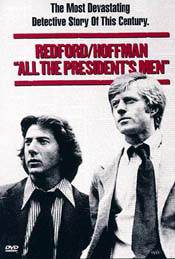
Saluting the President's Men


A few weekends ago I plopped down on my couch and watched the 1976 film "All the President's Men." Based on the book of the same title, the movie follows two Washington Post reporters who slowly unravel the Watergate scandal. Starring Robert Redford and Dustin Hoffman as journalists Bob Woodward and Carl Bernstein respectively, the movie garnered an Academy Award nomination for Best Film.

The plot of the movie reminded me of the TV show 24: political intrigue, mass cover-ups, secret informants, and a scandal that even reached the president himself. What's amazing to me is that this all really happened---it's not a story concocted by Hollywood writers, but actual historical events. And what's even more amazing is that the entire Watergate scandal would have remained a secret if it were not for a pair for tenacious reporters who refused to back down from their story.

In the past year I've become really interested by the role of the media in our society. On one hand I see the enormous good that comes from honest investigative reporting. The press informs the public of what's happening in the world; it sheds light on events that we, the people, have no access to. I especially laud the media for its continuiing coverage of Darfur and the atrocities that occur there.

But on the other hand, I see the growing sensationalism of the media. I know sensationalism has always been a problem in newspapers and magazines, but I think it's reaching new levels on television. I really don't understand why CNN and MSNBC describe Britney Spears' divorce as "BREAKING NEWS" or why Fox News was created specifically for a conservative base. Shouldn't news channels focus on...the news? And shouldn't news channels be created without an agenda? Some would argue that all news is biased in some way and I will agree to that. But at the same time, all media venues should at least try to be as non-biased as possible. Perhaps I am being idealistic, but then again idealism isn't a bad thing.

So, sure, there are a lot of downsides to any type of media. There are biases and hidden agendas and what-not. But there are also honest and worthy news sources that strive to inform their readership to the happenings of the world around them without a significant bias towards one side or the other. I'm just grateful that I live in a country where the freedom of the press exists and where it is celebrated. We can gripe and complain about the radical New York Times or the ultra-conservative Fox News Network, but at least we have news outlets to choose from. I mean, compared to China, we're doing really well.

Singin' the Blues

Justin is gone for two weeks of training and I've been awfully bored and glum lately. Despite having a long distance relationship, Justin and I see each other every weekend for three or four days and talk on the phone on the days we are apart. In describing my life, the oldies song comes to mind that goes: "Lonely...I'm so lonely..."

Haha. Well, life isn't that bad, but I've come to realize that I've neglected a lot of my friends since Justin and I started dating. It's not that I haven't wanted to spend time with them, it's just that my life has been so busy driving back and forth between DC and North Carolina. I know, I know: excuses, excuses. But I do feel really bad! I never wanted to be the kind of girl who ditches her friends once she's found a boy, but I've done this exact thing to a degree.

So what shall I do to regain the love of my DC-area friends?

1.) Kowtow before them and kiss their feet.
2.) Beg for forgiveness.
3.) Buy them chocolates.
4.) Buy them Orlando Bloom.

Ah, who knows. Maybe a phone call and a simple "I'm sorry" should do the trick...