Benji's Back!

About a month ago I posted a link to a Chinese music video starring a bonafide BYU Young Ambassador. Benji, as he calls himself, has now finished up his degree and is moving to China to launch his career as a "American Chinese pop Supa-star"! Yippee!

Benji's music video can be described in one word: CHEESE. It reeks of cheesiness: silly hip-hop dance movies, backdrops of Provo, and an Asian love interest. I giggled non-stop when I first watched it, thinking "Are you serious?" But indeed, Benji is very serious. And after I checked out his MySpace profile, over 1000 people find him to be very serious, too. I really think he's going to make it big in China. Benji is even negotiating with CCTV (Chinese Central Televsion) about hosting a show in China and he also received interest from MTV China to air his music video.

Hold the phone. (Haha. When's the last time you used that phrase?) I need to contact the Chinese people, stat. I need to bring to their attention a little something I call taste. I need to warn them about the Benji invasion. Run away, my cousins! Turn off your Communist-sponsored radios and television sets! Run away before Benji makes you turn into a squealing puddle of goo!

But my cries will fall on deaf ears because Chinese people eat this stuff up. They love cheesiness and they love Americans who embody cheese. Why? I don't know, but I do know my parents love to sing really loudly to strange Chinese karoake. Even my own family loves cheese.

It frightens me to no end that I could have been a screaming Benji fan if my grandparents had stayed in China rather than flee from the Communists. What would my life be like if I had grown up in Shanghai?

Would I look like this?

And make vertical peace signs when I pose for pictures?

And take pictures of myself with my web cam like this?


Would I have a neo-mullet and dye my hair red? Would I giggle incessantly and cover my mouth with my delicate hand? Would I wear shirts that read "Super Gas" across my chest? (True story, I saw a girl with a shirt like this in Beijing.) Would I have a Hello Kitty keychain and own an exhorbitant amount of stickers?

BLARGH! I'm getting the heebie-jeebies. Excuse me while I rock back and forth, chanting "I don't like Pokemon, I don't like Mao, and I don't like neo-mullets."

Line by Line, Precept by Precept

My career as a mathematician was very brief. In the fourth grade, I was the fastest multiplier and divider that Stonegate Elementary had ever seen. Thanks to good ol' Kumon math, I was as fast as lightning. 7 x 7? 49. 8 x 2? 16. 10 x 10? 100. Yep, I was that good.

My career as a scientist was even shorter (meaning I never had one). Much to my parents' chagrin, I was always a dunce when it came to science. Newton's Laws of Motion were foreign concepts to me as well as the organization of the Periodic Table of Elements (halogen what?). Good Chinese children excel at biology and physics and grow up to become doctors and engineers. My father received his masters degree in chemical engineering at the University of Virginia, but for some reason my dad's genetic affinity towards math and science was never passed down to me or my siblings. (Sorry Mom and Dad, but you'll have to look to your grandkids to receive the Tung family's first M.D.)

As much as math and science perplex and boggle my mind, I find them to be fascinating subjects. Especially theoretical physics, which attempts to explain the inner-workings of the universe on both macro and micro levels. Multiple dimensions, parallel universes, warp theory---oh my!

I'm currently reading Brian Greene's The Elegant Universe, which explains superstring theory (as well as quantum mechanics, special relativity, and general relativity) in layman's terms. The book truly is an exercise of my mind because these theories are so complex, even when they are dumbed down for dunces like me. Our universe is a strange place, my friends, and the laws that govern it on a macro level differ from the laws that govern it on a micro level. Weird. And not only are there four dimensions in space, there possibly may be a fifth, a sixth, and even more. Weirder.

Reading The Elegant Universe has made me greatly appreciate the lives and works of Isaac Newton and Albert Einstein. In many ways, Newton and Einstein are the "prophets" of science. They shattered previous methods of thinking and replaced them with their own radical ideologies. They are the "enlightened ones" who provided answers to centuries-old dilemmas. Their ideas have affected technology, engineering, and astronomy as well as culture and philosophy.

Of course, there are hundreds of scientists and mathematicians who have influenced the work of Newton and Einstein and these people cannot be ignored. Indeed, Newton and Einstein could not have rocked the world of physics without the discoveries of their predecessors. Every contribution, every discovery allowed for Newton and Einstein to change the world. But men like Sir Newton and Mr. Einstein only come around every few hundred years. Much like Jesus Christ, Mohammed, or Guru Nanak.

An interesting idea has been brewing in my head... In the scriptures we read that humans learn "line by line, precept by precept," meaning we learn a little bit at a time. We can't learn all the lessons we have to learn in a month or in a year. Instead, we learn a little here and we learn a little there, continually building up our well of knowledge and experience.

Thus it makes sense that the realm of science is dictated by this "line by line" methodology as well. Over six-thousand years ago when human civilization first emerged, our ancestors had only a rudimentary understanding of the world around them. Slowly, mathematics and the sciences developed. We grew to understand astronomy, biology, geology, chemistry, and physics. We mapped the constellations, developed measurements, discovered new species, and even harnessed nuclear energy. Our world today is a product of nearly 10,000 years of learning. And what's wonderful is that we will continue to better understand our world and our universe as time continues on---line by line, precept by precept.

OK. So if human understanding and science run on this line-by-line precept, then what about religion? What if, like physics, we are gaining a little knowledge here and a little knowledge there about the nature of god and the extent of his creations?

If this theory is correct, then religion cannot be static. It must be fluid---it must be willing to change and it must be willing to learn. When the human race was in its infancy, god revealed a small portion of his nature and his will to our ancestors. And now after centuries of progression, god continues to slowly teach us about his plan for mankind. Thus, to learn about god, we must learn about all faiths. If he has revealed a part of himself to the Jews and a part of himself to the Sikhs and a part of himself to the Zoroastrians, then we must look for him in these religions.

And if God indeed knows all things, then we must search for him beyond religion alone. We must study philosophy, art, science, history, literature, linguistics, mathematics---in short, everything. In D&C 93:53, God commands us to: "obtain a knowledge of history, and of countries, and of kingdoms, of laws of God and man, and all this for the salvation of Zion." The last portion of this verse is so interesting: all this for the salvation of Zion. In essence, we cannot progress if we refuse to learn. For learning is of God; and to learn is to be of Him.

God is far less mysterious then we are inclined to believe. (At least in my mind anyway.) If he loves us and is concerned about us, then surely we can find him. And with the wealth of religions and philosophies in this world, I know he is not very far.

Whatever Happened to...

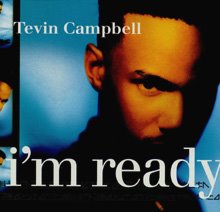
1.) Tevin Campbell?

When I was a sixth grader at White Oak Middle School, Tevin Campbell was the coolest R&B artist. (Although he could never touch the status of Ace of Base.) Tevin was the baby-faced crooner of hits like "I'm Ready" and "Can We Talk." His entire CD was really good and it produced single after single.

So what ever happened to Tevin Campbell? I think he lent his voice to the song "Stand Out" in "A Goofy Movie," but other than that, I haven't heard from him since.

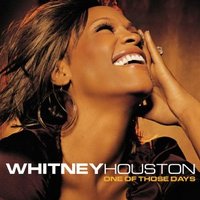
2.) Whitney Houston?

What happened to the lovable and cute Whitney of "I Want to Dance with Somebody" fame? Or the powerhouse singer of "I Will Always Love You"?

Drugs is what happened! And Bobby Brown!

But come back to us, Whitney. Please, come back. Ditch the white powder and your washed-up husband. Pull a Mariah and conquer the airwaves once again!


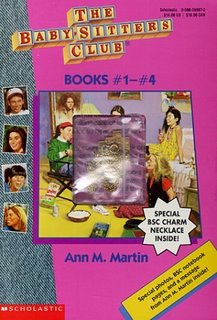
3.) The cast of the Babysitter's Club?

Some kids collect baseball cards. Other kids collect Pogs. I collected Babysitter's Club books. Why? Because they were awesome! I especially loved the Super Specials; my favorite being the one where the girls join their school's cast of "Peter Pan." Stacey and Sam (Kristy's older brother) were cast as Mr. and Mrs. Darling---and they were dating to boot! *Sigh* My ten year-old heart yearned for such romance.

So what happened to the Babysitter's Club? Did they live forever as eighth graders at Stoneybrook Middle School? Or did they eventually attend high school and college? Did Marianne and Logan ever get back together?

Tell me, Ann Martin, what happened to these girls!

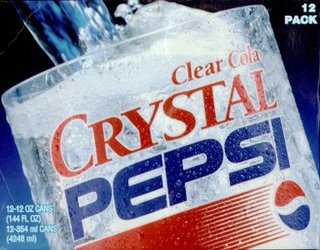
4.) Crystal Pepsi?

I thought Crystal Pepsi tasted good. And it fooled your senses because it looked like Sprite but tasted like cola. Ingenious! Crystal Pepsi was extremely popular at my elementary school. Like MC Hammer and Vanilla Ice, it was tre cool.


5.) Those delicious cookies that I don't remember the name of?

Yum...I'm drooling just thinking about them. They were mini chocolate-chip cookies that were filled with chocolate cream. They came in a box and they were available at any grocery store.

They still haunt my dreams, taunting me because they will always be out of reach---just like that guy in Greek mythology who is perpetually thirsty. He is surrounded by water, but every time he bends down to drink, the water recedes and eludes him. How cruel! Those Greek gods sure knew the meaning of punishment. (Am I being similarly punished by the Keebler Elves who have decided to discontinue making this delicious cookie in their cookie-making tree?)

Oui, Oui?

Last night, my roommate Tracy told me that France has changed its laws concerning naturalization. The government recently passed a law that requires applicants of French citizenship to speak French fluently. My roommates supported this change and then the topic was brought up about making English the national language in the U.S.

So I wondered: is it a good idea to make English the national language in our country?

Perhaps in some ways. Although the creation of a nation is regulated by a constitution and subsequent laws, the creation of nationalism is much more complex. Nationalism exists when the citizens of a country share a common history, a common dream, and numerous common traits. Indeed, Americans are a patriotic people because they share these three things. We look up to George Washington and Thomas Jefferson as our Founding Fathers; we dream about owning a home and pursuing an education; and despite our racial and ethnic differences, we all share much in common. We are generally religious and optimistic---and we all (most of us, anyway) speak English.

Our common language brings us together. We can converse freely with our neighbors and at the grocery store. We watch TV and movies that are broadcasted in a language we understand. And we send our children to schools where all classes are taught in English. Our language (and even our accent) is a way to feel part of a group. If you don't know English, then you're going to have a hard time fitting in.

Thus requiring a basic command of English could actually be a benefit to immigrants. To succeed in America, they have to be able to communicate with the rest of us. It is also essential to have a good command of English if they want to attend college here. Necessitating English-speaking skills as a precursor to citizenship could help immigrants find better jobs and obtain a higher education.


But this subject still makes me feel wary. For one, I don't think it's really necessary to make English our national language. We are all descended from immigrants, many of whom came to this country with absolutely no command of the English language. Yet they settled down, obtained jobs, and learned English. Granted, I'm sure there are some people who never gain fluency, but their children and grandchildren all grow up speaking perfect English. Why? Because second-generation citizens want to fit-in. Case in point, my parents spoke to me in Chinese a lot when I was little, but I learned English because I wanted to fit-in at school. (Speaking Chinese to white Americans doesn't make a girl a lot of friends!)

And isn't the nationalization of English a bit extreme? Perhaps even a little elitist? The U.S. has a lot of roots with Spanish-speaking peoples too. Would it be more fair to make English and Spanish our national languages?

Anyway, I guess there really are two issues at hand here: 1.) making English the national language and 2.) requiring immigrants to speak fluent English if they want citizenship. I don't think number one is necessary and I think number two is necessary only to an extent.

Am I being too lenient? Am I missing a bigger piece of the picture? Let me know your thoughts.

Ligers, Tigons, and Zonkeys, Oh My!

For some unknown reason, I stayed up late last night looking at pictures of animal hybrids. At 11:30PM I had watched a segment on the Colbert Report concerning a grizzly/polar bear hybrid that had been killed by a hunter. Intrigued, I went online to discover more of these "freak of nature" creatures. (What can I say? I'm a total nerd!)

Thank my lucky stars, I found an entire
site dedicated to animal hybrids! What I found most amusing was the names given to these forlorn-looking creatures: Zorse, Jaglion, Pumapard, Dogote. My favorite was beefalo. That just made me laugh, laugh, laugh. Beefalo!

Here are a few of the stranger-looking ones:


Zony --- Shetland Pony/Zebra Hybrid

Wolphin --- Whale/Dolphin Hybrid

Liger --- Lion/Tiger Hybrid (Considered the largest cats in the world)

Okapi --- Deer/Zebra Hybrid

OK, I'm just kidding about the last one. Okapis are actually forest giraffes (and the only living relative of the giraffe). Aren't they so cool-looking? And they only need five minutes of sleep per day!

Here's another interesting factoid: sheep and goat hybrids are called "geep" or, get this, the "toast of Botswana." Huh?

Anyway, I'm done being geeky. For crying out loud, I work at a space museum! Can I get any dorkier? Maybe if I start attending Star Trek conventions...

The Da Vinci Manifesto

Dear Dan Brown,

I have said it before and I will say it again: "You are a genius, my brother!"

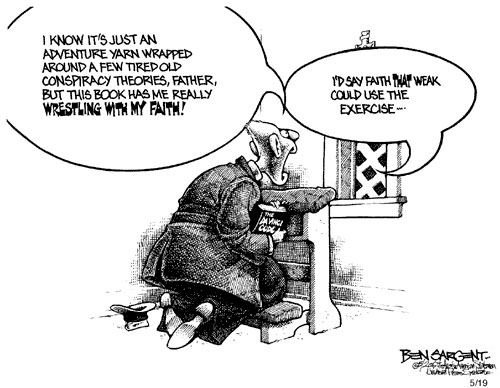
I thought Angels and Demons was good, but you truly saved the best for The Da Vinci Code. Who would have thought that an albino monk would make such a vile villain? Who would have thought that a Harvard symbologist would be such a perfect protaganist? And to top it all off, who would have thought that the passive voice could be used so frequently in one novel? Certainly not me or Toni Morrison for that matter. Sure, Beloved topped the New York Times' booklist for the best American novel published in the past 25 years, but Toni is no Dan Brown. (A fact that makes her green with envy, I'm sure.)

And so, let me be the first to say that I am absolutely appalled that The Da Vinci Code was not nominated on the list. If it makes you feel better, the film version of Beloved earned $23 million in the box office while the film version of Da Vinci scored over $85 mil in the opening weekend alone. If I was you, I would contact the judges who compiled the list and ask them to reconsider. They need to realize that they have made a gross error in overlooking your magnum opus. Cases in point:

1.) The Re-telling of History Factor. Thank you for giving Catholics, and all Christians for that matter, a good thrashing. It's silly for them to believe in the divinity of Christ because that is so, like, 4th century. Honestly, Christians should look to you as a modern-day Martin Luther. (Except you use your book for financial gain.)

And bravo on your research concerning the Roman Empire and the early stages of Christianity. I liked how you purposely ignored Constantine's converstion and instead focused on his baptism. It's so good of you to pick and choose historical dates and events to weave your own version of history. That makes it easier on your readers, many of whom are ignorant of Roman history and thus rely on your novel to tutor them.

Concerning the supposed tension between Christians and pagans, oh Dan, you rascally devil! You entirely fabricated a war between these two groups to strengthen your argument in Da Vinci. What a sly one! Little do your readers know that no wars existed between Christians and pagans in the decades preceding Constantine's rule. In fact, it was the other way around. Pagan emperors like Caracalla and Diocletian were the ones doing the persecuting. But I'm sure that is something you just overlooked. After all, you are not a "real historian," meaning you don't have a PhD. Those academics are so stuffy and elitist anyway! Who needs them and their carefully-researched monographs?

2.) The Novel-as-a-Movie-Script Factor. For decades, movie-makers have struggled to transform books into movie scripts. It's a long and hard process and one that is fraught with failure. More often than not, excellent books are butchered when they are translated onto the big screen. (Possession, anyone?)


But you do a kind favor, Dan, when you write your novels like a movie manuscript. The short chapters in Da Vinci mimic the quick scene changes in a thriller and the dialogue in the book is so predictable and cheesy that it practically wrote itself into movie form. And don't get me started on the two-dimensional characters who are so easily translated into standard movie archetypes: Robert Langdon as the intelligent protagonist, Sophie Neveu as the pretty French ingenue, Silas as the freakish henchman with a lot of emotional baggage, and Sir Teabing as the innocent friend-turned villain (didn't see that one coming).

You cut out the middle-man, Dan! Screenwriters will be out of a job soon if you keep churning out books like this. And Da Vinci has changed the novel as a genre. No longer will novels be judged by their artistic merit, but by their earning potential in Hollywood. What a relief! I can't wait for the blessed day when books will become obsolete. Thank you, Mr. Brown, for taking us a step further to this goal.

3.) The French Factor. Sexy Sophie Neveu, played by the doe-eyed Audrey Tatou in the film, reminds Americans that the French actually do have something to offer other than croissants and berets. The French may be snotty scalawags when it comes to international politics, but they sure have some pretty dames. And not only are French women beautiful and sophisticated, they also happen to be living descendants of Jesus Christ.

Americans who hate the French now must own up to the fact that they have something we don't---Jesus babies. If the Da Vinci movie can't build bridges between the U.S. and France, then I don't know what will. But I have faith in Dan Brown and his limitless powers of persuasion.

So there you have it: three excellent reasons why The Da Vinci Code trumps any other work of American fiction in the last 25 years.

Of course, there are some literary critics who would decry the compilation of such a list. Since the 1950s, some critics have questioned whether or not the novel is dead. Your book, Mr. Brown, finally proves that, yes indeed, the novel has sputtered, crawled into a hole, and died.

But is this necesssarily a bad thing? In your eyes, I'm sure it isn't.

Sincerely,
A Fan


Viva Las Vegas!

What a fabulous weekend! My best friend Alexis got married to a wonderful guy named Gabe Middleton. They complement each other so well and he treats her like gold. The entire weekend was full of happiness and fun. If Vegas wasn't so damn hot, I could have stayed there forever!

One of the best parts of the trip was seeing my friend Kristen. We met in London back in 2003 and we were roommates for three semesters afterwards. In August, I attended her wedding in California where Alexis and I were her bridesmaids. Now Kristen's married to a great guy named Jason and they're moving to Portland in June.

It was also great to see Alexis's sister, Alyson. (We kept each other company on the temple grounds when Lex and Gabe were getting sealed.) She's moving to DC in a few weeks to intern at the National Postal Museum. Don't be sad, Aly. Stamps are cool!

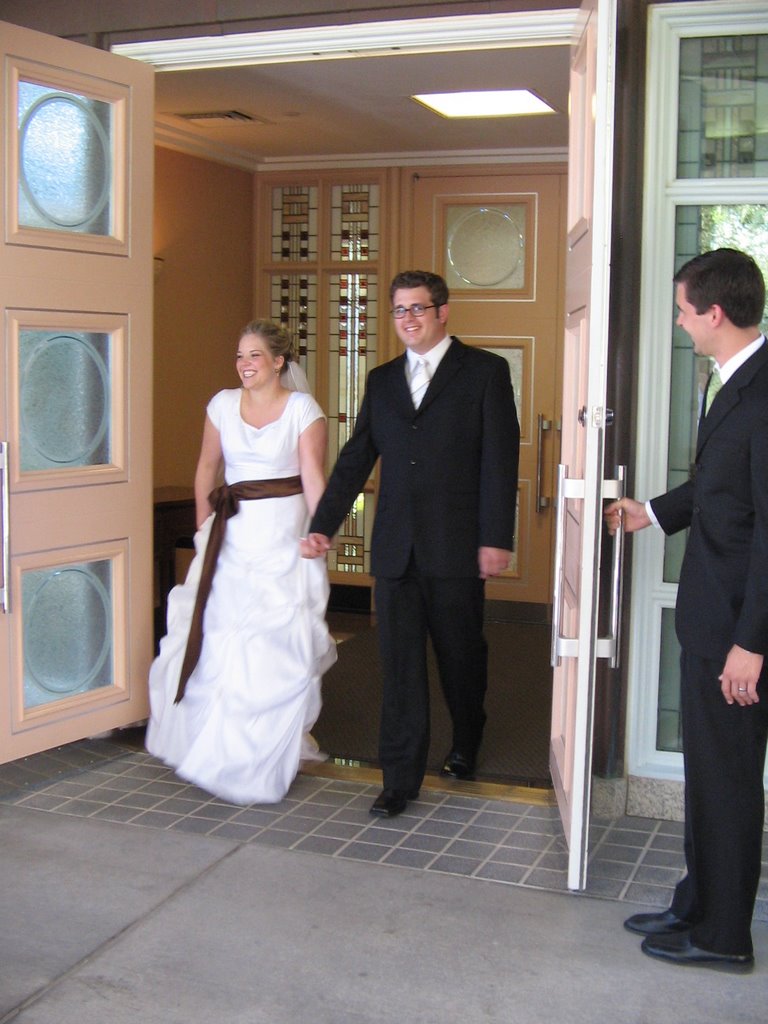
The happy couple emerges!

Gabe and Alexis met at---where else?---BYU. They were in the same ward at the Colony and started dating in January 2005. (Alexis likes to add that they were friends since September 2004.) As far as BYU dating goes, Lex and Gabe dated for a long time---a total of eleven months before they got engaged. Their engagement lasted six months so they've been dating for a year and a half before they got hitched. Yay for not rushing into marriage!

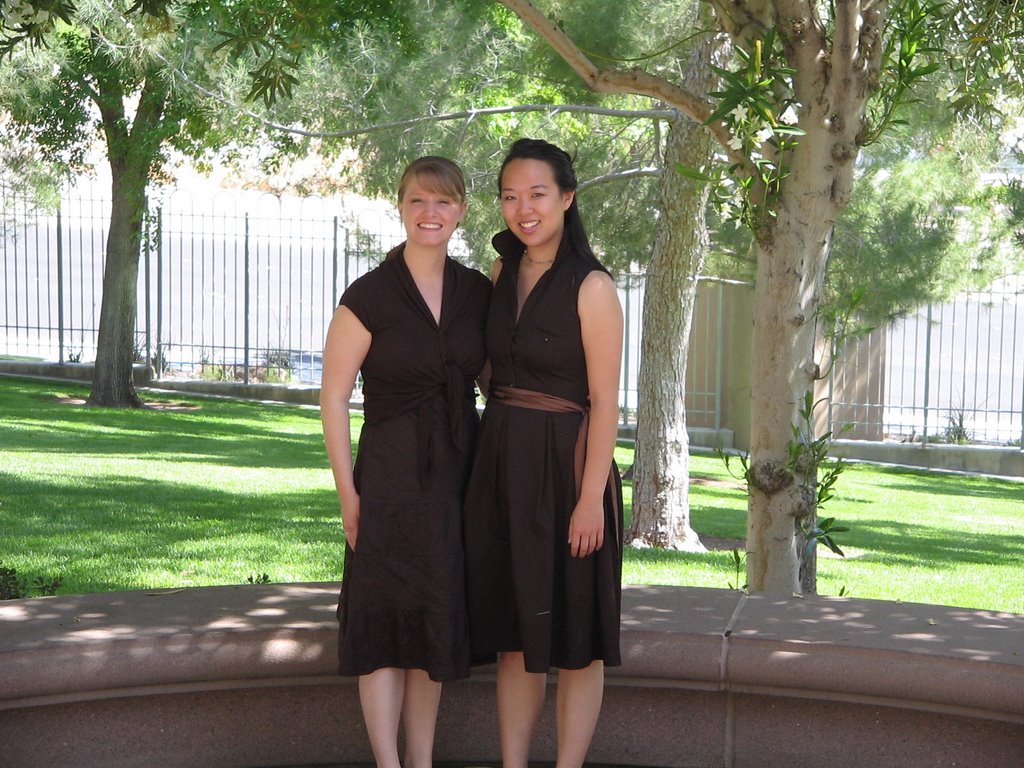
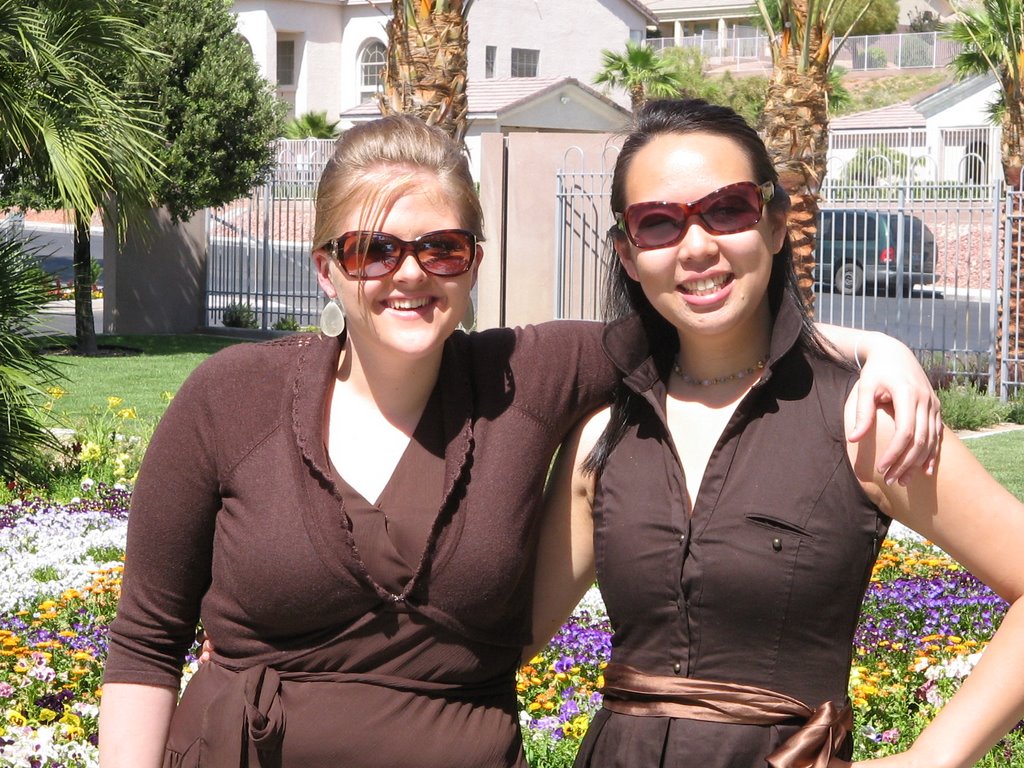
Alexis had eight bridesmaids---her two sisters, three friends from high school, and three friends from BYU. Since her bridesmaids were scattered across the U.S., Lex had us choose our own bridesmaid dresses (our only job was to make sure it was brown). I was a bit worried that our dresses would clash, but everything turned out so well. All of us bought dresses in the same hue of brown and in the same length. I loved my dress! I got it at Zara and it has a retro look to it. The only negative side? It was too tight on my arms. Ouch. What can I say? I have chubby arms.

My favorite part of my outfit was my bouquet! Alexis's colors were green and brown so her bridesmaids wore brown and carried green bouquets. I think her florist did a terrific job.

Aside from Aly's lovely face, please draw your attention to the temperature on the rearview mirror. 107 degrees!!!

What's Vegas without a little gambling? On Sunday, Jason, Kristen, and I went to a brunch buffet at the Rio. (We wanted to go to the Wynn, but their Mother's Day buffet cost $35!) Afterwards, we played a few slot machines. I lost all of my money---a grand total of $2.25. Punishment for breaking the Sabbath...

Kristen must be on God's good side though because she won seven dollars! She put in one quarter into a slot and won on her first try. Not fair!

All in all, a fabulous little vacation!

I couldn't be happier for my friend. I couldn't have eaten more food. And I can't be more excited to get married in the temple one day. (In the distant, distant future!)

It's the small things...

How did I get here?

(I don’t mean in the ethereally philosophical sense.)

I mean, how did I get here—sitting in a cubicle in the National Air and Space Museum, waiting for September to roll around so I can start grad school, and volunteering at the Save Darfur Coalition in the mean time?

I think I got here through a series of seemingly insignicant choices...

It all started my junior year of college, back in September 2002. Fall semester that year was awful. I was only taking twelve credits, but my classes were killing me. My two history courses required hours of reading and hours of cramming. (It didn't help that they were totally unrelated to one other---"Traditional Chinese History" and the "History of the American West.") Even though I stayed at the library until 12AM every night, I still felt like I was lagging behind.

Not only was I burnt out on academics, I was also burnt on in my social life. My three roommates all had boyfriends and I was feeling a bit left out. To counter my dating woes, I decided to befriend all of the boys in my apartment complex. (I did a pretty good job! Only a few males were able to escape the chains of my friendship.) I made a lot of friends and acquaintances that semester, but I doubted if any of them truly cared about me. I was very sad.

Some time in November I had a breakdown. It wasn't a nervous breakdown by any means, but I was frustrated, hopeless, and depressed. I didn't want to study and I didn't want to socialize. I just wanted to go home. Luckily for me though, I had wonderful roommates who helped me through my troubles. They listened to me and they prayed for me. They offered me hope and lots of love. Through this trial I learned to take better care of myself: I learned to balance my life better and I realized I stressed too much over the small stuff.

Come January I was feeling better, but I was still itching to get out of Provo. I decided then that I needed to spend a few months abroad and so I applied to BYU's London program. In February I found out I had gotten in and in September 2003 I hopped across the pond to spend the next four months of my life as an ex-pat.

I didn't realize it at the time, but my semester abroad changed my life. In fact, I often divide my life into two halves: pre-London and post-London. Even now---nearly three years after my study abroad---I can still see its effects in my every day life:

1.) My job. When I was in London, I became fascinated with museums and I decided to pursue a career in the museum world. After I returned to BYU, I interned at the Springville Museum of Art in Fall 2004 and at the MOA in Winter 2005. These internships helped me land an internship at the National Air and Space Museum---where I currently work.

2.) My graduate studies. After my semester abroad, I took a history course from Dr. Paul Kerry. Dr. Kerry was a wonderful teacher and he was also a wonderful advisor and friend. He encouraged me to pursue a graduate degree---and to pursue it in the U.K.

Dr. Kerry undertook his PhD at Oxford and he knew I was enamored with British life. "Why not get your masters done in a year and enjoy yourself in England?" he asked. What wonderful logic!

3.) My trip to China. The class I took from Dr. Kerry was entitled, "Public History and Popular Memory." Basically, we studied history in the public sphere---museums, memorials, historic homes, documentaries, etc. After we studied the failed exhibition of the Enola Gay (ironically at the National Air and Space Museum), I became fascinated by how museums reflect and shape public opinion.

Thus, I decided to apply for an ORCA grant to study museums in communist China. In May, I went to China for the first time with my papa. Not only did I visit a lot of museums, I also got to eat a sea cucumber! (Kind of gross.)

Coincidentally, when I visited the Great Wall, I struck up a conversation with a professor from a college in California. I expressed to her that I wanted to study history in the U.K.

"Have you ever thought about the London School of Economics?" she asked.

Enough said.

4.) My friends. I consider myself such a lucky girl to have met so many wonderful people on my study abroad: Alexis, Kristen, Janice, Lisa, Lindsey, Kristen D., Heidi, Kim, Leslie---oh, the list is endless! And I'm headed to Las Vegas tomorrow to attend Alexis' wedding!

5.) My first real, earth-shattering heartbreak. Hmmmm...we probably don't need to go into detail about this! But my first real heartbreak has taught me so much about love, about marriage, about relationships, and about faith. It has broken my soul and it has challenged me in ways that I never thought I would be challenged. It has been the toughest trial in my life (I guess I haven't been through very much, eh?). But I have emerged from it a stronger and a more open-minded person. I have learned greater empathy and greater patience. I know I am a different person because of it---and for the better.

So there you have it. How did I get to this point in my life? Through a lot of little choices here and there, through a few big trials, and through a lot of prayer and faith.

As I embark upon my second journey to London, I can only hope that it will be as fruitful as the first.

They're Mine!


Whenever I have lunch at the National Gallery of Art, I just have to stop by the 4th floor to look at my Georgia O'Keefe's. (I like to say their my O'Keefe's because I'd like to own one some day. This, of course, is a near impossible dream!)

I was never a fan of O'Keefe until I saw her work in person. Only then did I see the careful gradiation of her colors, the smoothness of her strokes. Her paintings are so bold, yet feminine. And for some reason I think they look very American.

Some people say that OKeefe's paintings display overt sexuality--- that they look like female genitalia. (I suppose I can see a resemblance. In a sense, flowers are vaginas after all.) But when I look at an O'Keefe, I see pretty colors swirling together and I see peace. I guess that's why I love to visit the 4th floor whenever I get a chance.

10 Hour Work Day with No Pay, but Utterly Satisfied


On August 28, 1963, a crowd of 350,000 Americans flooded the National Mall to participate in the historic March on Washington for Jobs and Freedom, where Dr. Martin Luther King Jr. delivered his iconic "I Have a Dream" speech. Six years later on November 15th, 1969, over 500,000 protestors rallied together on the Mall to denounce the Vietnam War. And in 1987, half of a million gay men and women gathered to demand equal rights.

Since 1894, over twenty protest marches have taken place on the National Mall, with most of them attracting crowds that numbered in the hundreds of thousands. Thus compared to its predecessors, the Rally to End Genocide (which took place on Sunday) was a small-town gathering. The JTA gave an estimate of 75,000 partipants while The Washington Post tallied a mere 10-15,000. Nevertheless, the rally, which was held beneath the towering height of the Capitol, was a success. Whereas protests for civil and gay rights attract a relatively homogeneous crowd, the Rally to End Genocide attracted a spectrum of American and international participants.

The first participants I met were three high school girls from New York City who came down with their local JCC. My friend Lauren met an elderly woman who came to the rally with her synagogue. Participants hailed from Boston, Philadelphia, and Portland, Maine. Some people drove all night from Atlanta; others flew from Seattle. Parents brought their children; teenagers brought their parents; grandparents came with other grandparents. I saw white faces and black ones, Asians and Indians. I encountered Jews, Muslims, and Christians. I even chatted for a few minutes with one of my friends from BYU---a Utah boy who was spending his Sabbath protesting for Darfur.

My fellow volunteers were an eclectic bunch. One of my favorite volunteers was Steve Orrison, who worked for NATO for eighteen years and who was married to a French woman (who was also volunteering at the rally). Both of them were in their sixties. And even though Steve has back problems, he spent the entire day lifting and carrying boxes, working from nine in the morning well into the evening.


Then there was Samantha, a rail-thin blonde who was a freshman at George Washington University. There was Lauren, a graduate of Penn who worked in micro-finance. There was an African-American teacher who lived in New York City during 9/11. There was a seventy-year old man who had a long white moustache and wore a cowboy hat.

Many volunteers were recent graduates who now work in the non-profit world. I felt a kinship with them, even though they majored in international relations or public health when they were in college. I think a lot of us dreamt of saving the world after graduation, building huts in Peru or teaching English in Africa. But I guess the logistics of the "real world" eventually burst our bubble, making us realize that we can't save the world on $30,000 a year.

We worked hard at the rally---lifting boxes, unloading trucks, selling merchandise, policing the crowd, picking up trash. We put our hearts into what we did because, sadly, this was all we could do. No matter how loudly we shouted for help to save the refugees in Darfur, we needed the government's help to bring this tragedy to an end.

And so when the rally concluded, I felt a sense of hopelessness. Sure, I spent the entire day as a volunteer, but was that enough? Could a little rally in Washington, D.C. salvage the lives of millions of Sudanese refugees? Would the rally cause the government to take more political action in Darfur?

The lesson I learned is this: no matter how hoarse our voices become, we need to keep shouting for help. We may not be able to end the genocide in Darfur, but that doesn't mean we should do nothing. Apathy is our greatest enemy. As long as the genocide ensues, I will continue to volunteer at the Save Darfur Coalition. In the end, we may fail and we may fail miserably. But our time will not have been wasted. A worthy cause is never a waste. Hope is never a waste.

Again, we may fail, but there is also a slim chance that we may succeed. Today, President Bush urged the president of Sudan to bring peace to Darfur. Our hope has brought us this far; and I can only hope that it will bring us even farther.